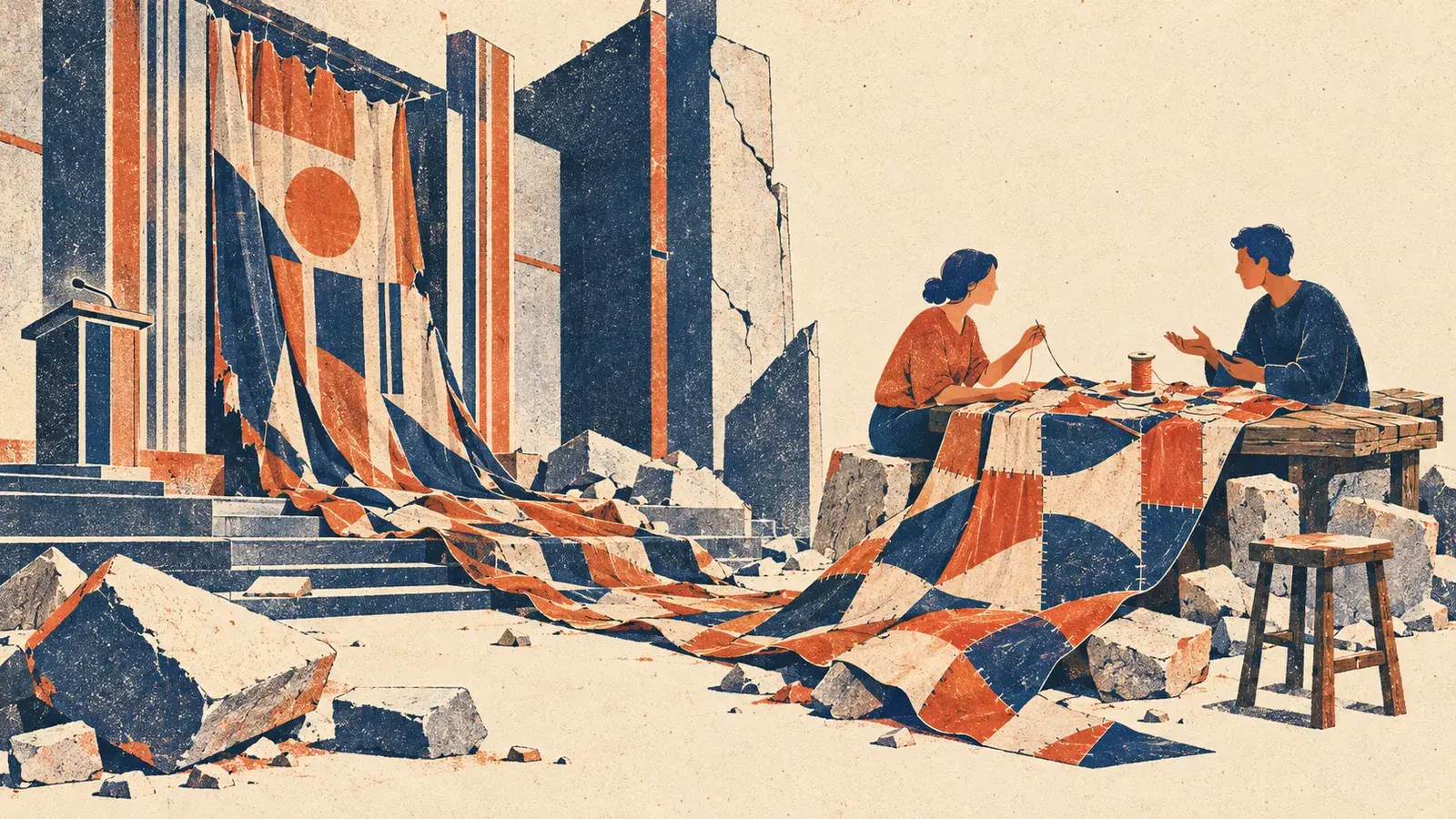
Nate Hagens welcomes social thinker and author Dougald Hine, a former BBC journalist, co-founder of the Dark Mountain Project and the School Called Home, and author of “At Work in the Ruins.” The discussion revolves around the end of modernity, grief for the future we took for granted, the place of storytelling and art amid collapse, and the possibility of working meaningfully in the ruins.
Hine reads an excerpt from his book: a night of meteors in early 2020, when his young son wishes for a fire engine. He describes the web of extraction that surrounds us with objects that seem to spring magically from the ground. In the excerpt, he connects becoming an adult with a ritual encounter with mortality and concludes that being an adult means living alert to consequences and knowing the cost of your existence.
Hagens asks why the spoken words moved him more than reading them. Hine replies that he has spent his life among storytellers and learned to trust the way storytelling helps us inhabit the world. He mentions a storyteller from Uzbekistan whom his friend Alan Garner met: the man trained from the age of eight to forty before he was allowed to tell a story before an audience. This, he says, shows that in many cultures storytelling was a matter of life and death, not entertainment.
Hine argues that stories do not need to be happy; they need to draw us toward meaning and allow us to recognize ourselves. He mentions artist Lydia Catterall’s observation that you can be grateful for something you could never have asked for, and the example of Nick Cave, who publicly shared his grief after his son’s death and helped others break through the isolation of loss.
According to Hine, many people deeply engaged with the metacrisis arrived there through personal tragedy or sorrow. He describes a gentler path for himself: he left an early career at the BBC almost by accident and was forced to ask what was worth doing with his life. From there, he found himself on a path where the environmental crisis, which he had known about since the years of Chernobyl and the Earth Summit, became connected to broader questions of meaning.
Hine stresses that grief is neither a recipe nor a prerequisite, but something most people will encounter. Modern Western culture, he says, is afraid of death; by contrast, almost all older cultures knew better how to grieve. He mentions Ellie Robbins’s study of the suppression of lamentation in ancient Athens before the founding of Athenian democracy, and notes that we may still be living with the consequences of that suppression.
Hine argues that modernity is built on ruins, as people who looked like us destroyed other worlds in the name of progress. He cites anthropologists Mario Blazer and Marisol de la Cadena, who say that, to Indigenous people, the discussion of the Anthropocene looks like the moment when the powerful realize that their own world can end too. He uses Bruno Latour’s image of a plane that cannot land in either the global or the local, but can only come “down to Earth.”
He explains why he stepped away from the discussion of climate change. This was not advice for everyone, but a personal realization that the politicization of science was making it increasingly difficult to ask broader questions. Art, he says, is neither a communication tool nor a cheap advertising agency; it is something stranger and less instrumental. Climate change raises questions that climate science cannot answer, such as whether we ended up in this mess through bad luck in atmospheric chemistry or because of a way of relating to the world.
Hine distinguishes the work of scientists from science as an ideological construct. He recounts how, after Newton, the early deists tried to replace fragile human judgment with the promise of calculation, hoping there would no longer be anything to fight over. The same pattern was repeated, he says, in the environmentalism of the 1990s, when we decided to set aside questions of meaning and present only data, expecting everyone to change.
Despite his criticism, Hine does not reject science. He describes four tasks for an age of endings: salvaging the good things we can take with us, grieving what we will not manage to save, discerning what was never as good as we claimed, and picking up the threads that were deemed obsolete. He mentions that Richard Smith, former editor of the British Medical Journal, applied these four tasks to medicine in a review of his book. He adds that rebuilding local skills, as Ivan Illich said, is the best preparation for the worlds to come.
The term “engaged surrender” comes from his friend Rebecca Bandt, an intensive care nurse. She observed three attitudes among patients’ families: denial and withdrawal, an obsessive fixation on data, and a rarer attitude of presence without illusions of certainty. Hine sees a model for our times here. As an example, he mentions Maura O’Connor’s book “Ignition”: she trained as a wildland firefighter and learned useful skills alongside people with different educational backgrounds and political views, finding respect, cooperation and meaning on the front line of the fire.
Hine proposes shifting our attention from the future “uninhabitable Earth” to the present lack of a habitable world, especially for young people. He quotes David Fleming: the things that make us come alive are often humble and light, while the things we “need” to participate in modern society have the large footprint. At the School Called Home, which he runs with his partner, he promotes the approach of institutions that begin at the kitchen table: small gatherings, neighborhood relationships and experiments such as the Spencer Street Folk School and Sand River Community Farm.
He says he does not give easy advice to young people aged 18 to 25; he prefers to listen to what it is like to be that age. He recognizes that they are captives of modernity within educational institutions preparing them for a world that will not exist. As a young man, he was helped by finding a few trusted adults who showed another way to be an adult, such as Alistair Macintosh with “Soil and Soul.” Asked about a magic wand, he responds with Martin Shaw’s image of shutting down the internet for a month and the idea of a “12-step” program for the whole civilization.
He closes with the reminder that no one knows how this story ends and that it is extremely unlikely we will see the end of the human experiment within our lifetimes. This does not reduce the scale of the problem, but allows us to participate without a guarantee. As written in the Dark Mountain Manifesto, there is a hope beyond hope, paths toward the unknown world that lies beyond the end of the world as we knew it.

Comments