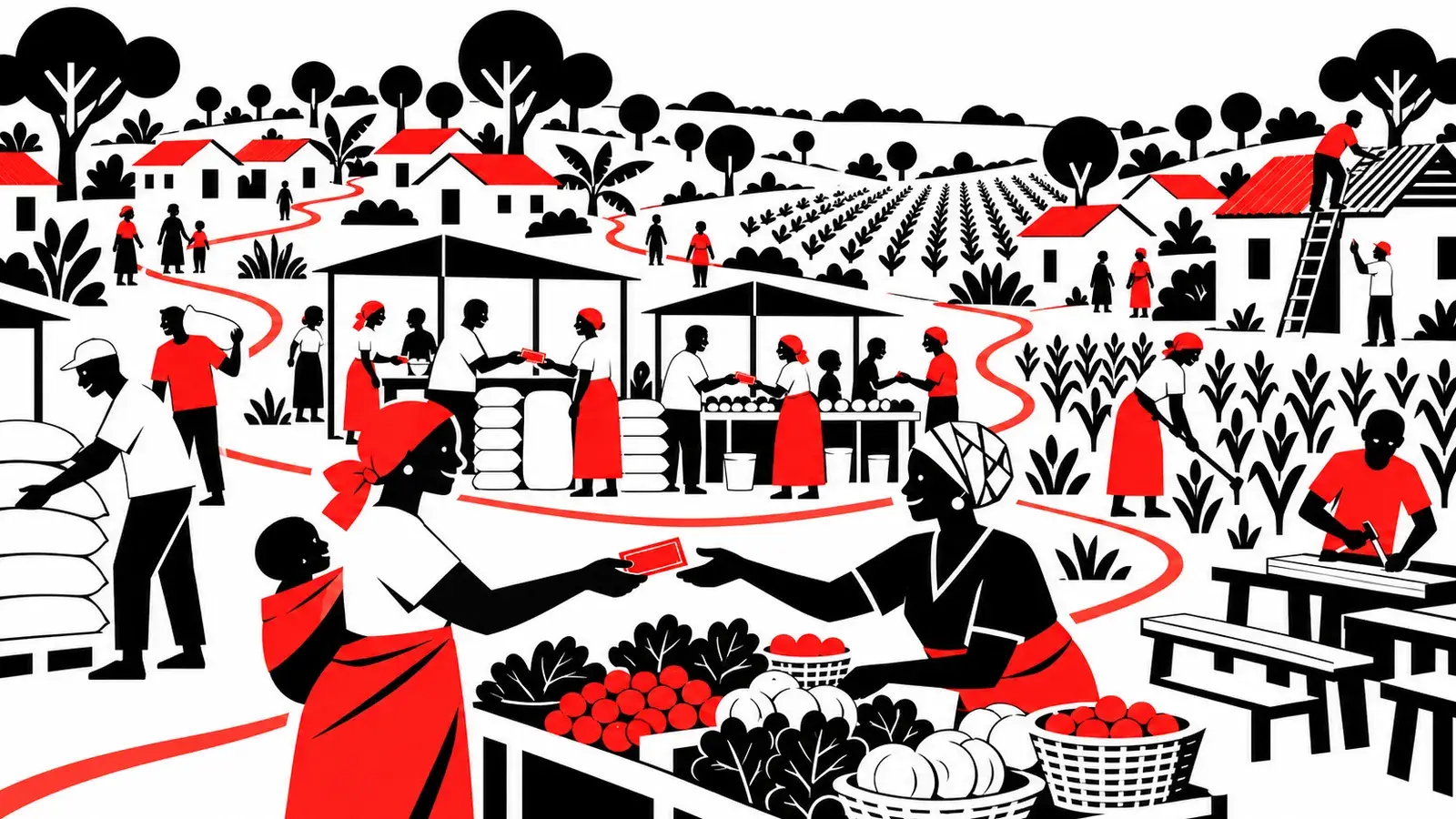
GiveDirectly has launched its largest program to date in two of Malawi’s poorest rural areas. By the end of 2026, around 120,000 households will have enrolled to receive an unconditional, one-time cash payment, with the total amount in these areas equivalent to about 85% of local GDP. The aim is not only to improve recipients’ lives but also to test a broader question: can direct cash transfers, at a large enough scale, transform entire economies?
Development economics has often divided the problem into “micro” and “macro”: what helps a household today and what makes an economy grow over the long term. GiveDirectly argues that this distinction is artificial, because an economy ultimately consists of the households and businesses within it. If changes happen simultaneously in enough of them, individual results may add up to something bigger.
The effects at the household level are already well documented: hundreds of studies show that large, one-time transfers help poor households increase their incomes, spending and assets. At the same time, however, most of the 1.5 billion people who have escaped extreme poverty since the 1990s did so because their national economies grew: jobs were created, wages rose and new opportunities opened up.
There is evidence that the benefits can spread beyond recipients. In Kenya, cash transfers increased the incomes of both recipients and neighbors who received no cash: as recipients spent more, businesses earned more and money circulated through the local economy. According to the organization, every dollar transferred generated about $2.50 in local economic activity.
The experiment in Malawi is designed to test whether these results are repeated when cash reaches a much larger share of the economy. It is hard to overstate the scale: proportionally, the amount is equivalent to a one-time payment of about $114,000 to every adult in the United States. The organization notes that such an injection would be felt by recipients themselves, their neighbors and the entire local market.
The program is also testing how decisions by businesses and households affect the overall result. Around 1,650 Malawian businesses are receiving grants labeled for buying stock and expanding, while researchers examine whether telling businesses in advance that cash is coming helps them prepare for increased demand. Additional interventions, such as financial guidance and smartphones, are also being tested to see whether they make the benefits more lasting. Monitoring does not rely solely on questionnaires: satellite images, mobile money records and economic models are being used to track jobs, businesses, prices and the risk of inflation.
Key questions are whether the changes will stick, how large a program needs to be for effects to emerge across an economy, and which areas are best suited to this kind of spillover.
The program is also examining how cash can complement public systems, such as shared registries of people who need assistance, social protection programs, and health and education services. Poverty is not only about income: researchers are also tracking housing, food sufficiency, children’s school attendance and households’ ability to absorb shocks such as a failed harvest.
The implications could extend beyond Malawi. Progress against extreme poverty has slowed globally, and the sector is looking for solutions that can be scaled up.
If transfers at a sufficient scale create lasting gains in jobs, businesses and incomes, governments and donors will gain a tool not only for improving lives at the margins but also for growth from the bottom up. If they do not, that finding will be equally useful, clarifying where cash is effective and what else communities need to leave poverty behind for good.



Comments