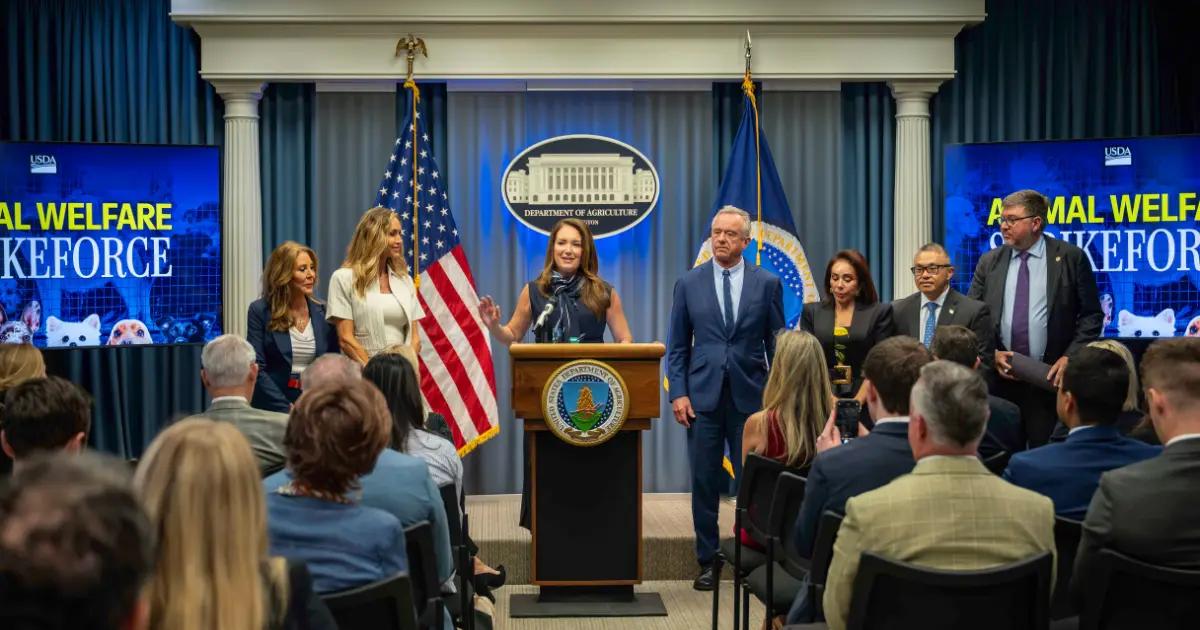
The US administration is promoting a series of changes it presents as a “new era” of animal welfare, but the plan leaves out the vast majority of animals cared for by humans in the United States: cows, pigs, chickens and other animals raised for food.
The US Department of Agriculture (USDA) announced plans in September to update the Animal Welfare Act, while the Food and Drug Administration (FDA) issued a rule allowing pharmaceutical companies to test drug safety without using animals, replacing terms such as “animal testing” with “nonclinical testing.”
Humane World Action Fund president Sara Amundson called the change a “historic milestone” in efforts to dismantle “outdated federal policies” that had entrenched animal testing in drug development. Meanwhile, Agriculture Secretary Brooke Rollins announced a plan to improve the welfare of companion animals — especially dogs — covered by the law, with a proposal in 2027 to update standards for dogs addressing medical care, exercise and socialization.
However, the federal Animal Welfare Act protects only companion animals, certain warm-blooded animals used in research, and warm-blooded animals in zoos or exhibitions. It does not cover animals raised on farms for food or those used for other agricultural purposes at all, even at the USDA’s own facilities.
For farm animals, only limited laws cover certain stages of food production — such as the Humane Methods of Slaughter Act and the “28-hour law,” which limits how long animals can travel without food, water or rest. But these laws are “poorly enforced,” according to Delcianna Winders, a professor at Vermont Law School and director of the Animal Law and Policy Institute. A 2026 review by the Government Accountability Office found that between 2013 and 2025, the USDA referred only one potential violation of the 28-hour law to the Department of Justice, and no action was taken.
The Trump administration is also promoting changes to slaughter. Winders says the USDA is “moving ahead with efforts to increase slaughter speeds to as many as 175 chickens per minute” and warns that “extreme slaughter speeds mean less time to properly handle and stun animals, so more animals will be dragged, kicked, scalded and skinned alive.”
With farm animals excluded from federal law, oversight is left to the states, which, however, “do not fill the gap,” as Winders writes. A USDA analysis in 2022 showed that only 14 states had enacted policies overseeing farming practices, largely limited to the confinement of pigs, laying hens and veal calves — only a small part of production. Some of these state regulations are also being challenged at the federal level, including through the so-called “Save Our Bacon Act” in the 2026 farm bill, which would overturn state restrictions on the use of cages.
When Sentient Media contacted the offices of Health Secretary Robert F. Kennedy Jr. and Agriculture Secretary Brooke Rollins to ask why farm animals are excluded from the “new era” of animal welfare, it received no response. The contrast is telling: on one side, rhetoric about respect and accountability; on the other, the reality that the billions of animals that end up on our plates remain largely invisible to the law.




Comments