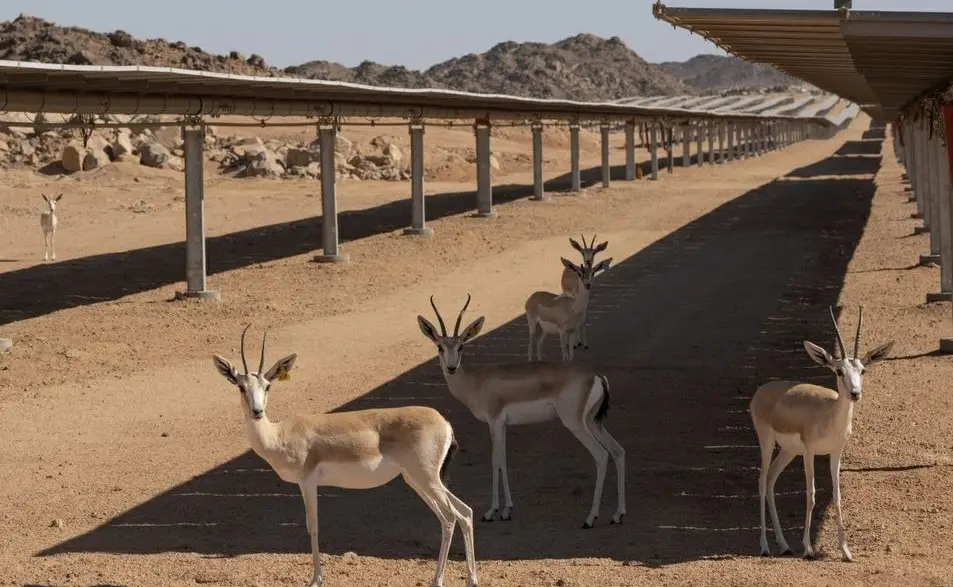
A large solar park in Saudi Arabia has unexpectedly become a breeding shelter for the Arabian sand gazelle, a vulnerable native species. The 250-megawatt facility, located near the Red Sea coast inside a 24,500-square-mile nature reserve, was built to power the country's all-renewable tourist resort Amaala. Today it is also home to 38 sand gazelles.
Conservationists say the species is widely kept in zoos, but only around 3,000 animals are believed to remain in the wild across the Arabian Peninsula and Turkiye. At the solar plant, the gazelles live within 1,200 acres enclosed by wildlife-proof fencing. The protected area gives them room to feed, breed and explore while keeping predators out.
The hope is that the founding group can multiply and eventually exceed 500 individuals. Those animals could then be used to reestablish a strong, self-sustaining population inside the much larger reserve.
Andrew Zaloumis, the reserve director, said the rewilding goal is to build wildlife populations that survive without ongoing human intervention. He described the approach as a 'double-green' framework with global scalability, calling it 'ReWildingVoltaics.'
Other animals have also joined the site. Mountain gazelles and Arabian hares were released into the solar park last October. In May, after it became clear the animals were settling in, males were added in hopes of establishing a self-perpetuating population.
The arrangement works in part because the solar panels create shade that is between 8 and 18 degrees cooler than the surrounding Arabian sunshine. The report notes that similar multi-use solar ideas have already shown benefits with sheep pasturing and crops grown around and beneath panels.
According to the Saudi Gazette, the initiative supports Saudi Green Initiative targets: protecting 30% of the kingdom's land and sea and generating 50% of its electricity from renewable sources by 2030. The project therefore pairs clean-energy infrastructure with direct conservation benefit.


Comments