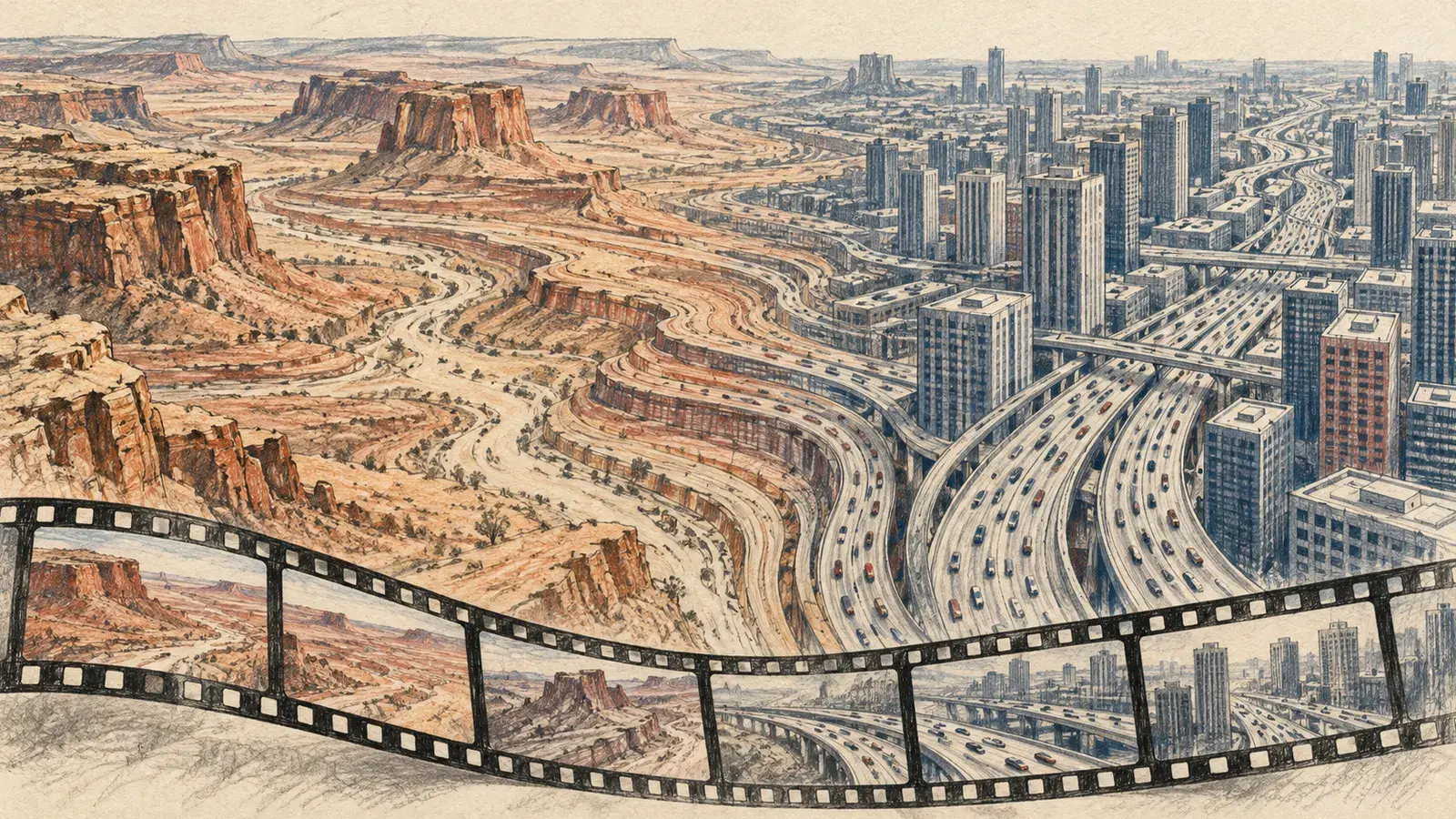
Koyaanisqatsi is a 1982 non-narrative documentary directed and produced by Godfrey Reggio, with music by Philip Glass, cinematography by Ron Fricke and presentation by Francis Ford Coppola. The title comes from the Hopi word meaning “life out of balance.” It is the first film in the Qatsi trilogy, followed by Powaqqatsi (1988) and Naqoyqatsi (2002), and is considered both the best-known film in the trilogy and a cult film. With a budget of $2.5 million, it earned $3.2 million at the box office and was among the most commercially successful documentaries of the 1980s.
The film runs for 86 minutes and consists of a montage of images accompanied by minimalist music that lasts almost as long as the film itself, with no narration, dialogue or intertitles. It is structured in 13 sections separated by pronounced changes in the music. It opens with rock paintings from the Great Gallery in Horseshoe Canyon and a close-up of a rocket launch, while a deep voice sings the title. These are followed by landscapes, sand dunes, time-lapse clouds, waterfalls and ocean waves in slow motion, and then images of resources: reservoirs, cultivated flowers, surface mining, electricity infrastructure, evaporation ponds, oil drilling, blast furnaces and a nuclear test that forms a mushroom cloud over the desert.
The next section shows people sunbathing beside a power plant and visitors taking a tour inside it. Then come reflections of clouds in glass skyscrapers, Boeing 747 aircraft taxiing, highways, military vehicles and aircraft, and air-to-ground weapons. These are followed by modern New York skyscrapers and areas of urban decay, with derelict buildings and demolitions that raise large clouds of dust. The section ends with time-lapse footage of cloud cover and sunlight reflected on building facades, and people walking along busy streets in slow motion.
In one of the best-known sequences, the music's tempo accelerates while time-lapse footage shows cities at night, vehicle lights moving quickly, walking crowds, shopping malls, factories, food processing plants and television channel surfing. The music and images reach their maximum speed, followed by silence. The finale combines close-ups of microchips with satellite photographs of urban networks, while the faces of people from all walks of life appear, some looking directly into the lens. At the end, Hopi prophecies are heard, a rocket explodes shortly after launch, and the camera follows its debris as it falls toward Earth.
The production grew out of a 1972 campaign by the Institute for Regional Education (IRE) in Albuquerque, sponsored by the American Civil Liberties Union (ACLU), on invasions of privacy and the use of technology to control behavior. Instead of public service announcements, the IRE bought advertising airtime and used more than thirty billboards, one of which showed a close-up of a human eye. Reggio described the campaign as extremely successful: Ritalin was eliminated as a behavior modification drug in many New Mexico school districts. But when the ACLU withdrew its sponsorship and a fundraising effort in Washington failed, the institute was left with $40,000; Fricke insisted that the money could fund a film.
Filming began in 1975 in St. Louis on 16 mm film because of the limited budget, although the team preferred 35 mm. Fricke filmed the Pruitt–Igoe housing complex from a helicopter and nearly fainted, as he had never flown in a helicopter before. There was no formal script; Fricke shot whatever he thought would look good on screen. In New York's Times Square, he set up a gray backdrop and began filming passersby who thought they were posing for a photograph; Reggio initially thought the idea was silly, but when he saw the footage, he devoted an entire section to portraits. The initial funding ran out, but the IRE continued to receive funding, and in 1976 the production switched to 35 mm, filming in Four Corners for its “otherworldly” appearance.
Time-lapse became a central means of expression. Fricke bought a Mitchell camera and built a motor with an intervalometer that allowed precise camera movement between frames and ran on a battery lasting twelve hours. Most time-lapse footage was shot at around 1.5 frames per second, while the Los Angeles highway shot used a double exposure: twelve hours during the day and twenty minutes at night. The shot of the Boeing 747 at Los Angeles airport was the film's longest continuous shot and required two weeks of daily filming. Footage by filmmaker Hilary Harris and cloud footage by Louis Schwartzberg were also added during editing.
Philip Glass composed the music, performed by the Philip Glass Ensemble under the direction of Michael Riesman. The soundtrack is a characteristic example of minimalism, with repeating figures, simple structures and a tonal harmonic language. The word “koyaanisqatsi” is chanted at the beginning and end by a deep bass voice, while three Hopi prophecies are sung by a choir before the closing credits. Reggio said that the Qatsi films are not about the effect of technology or industry on people, but about how “everything exists within technology” and how “we do not use technology, we live technology.” He also explained that he chose the Hopi word because he wanted “a word without cultural baggage,” and that the absence of dialogue stems from language being “in a state of profound humiliation.”
The film premiered at the Telluride Film Festival on September 25, 1982, and was screened at the New York Film Festival at Radio City Music Hall. The newly formed Island Alive handled distribution, and the initial limited release took place at San Francisco's Castro Theatre on April 27, 1983, where it earned $46,000 in one week. It reached a total of $3.2 million, became a surprise hit in arthouse theaters and among college audiences, and in 2000 was selected for preservation in the Library of Congress's National Film Registry as “culturally, aesthetically or historically significant.” Ron Fricke went on to direct Baraka, a purely cinematic film often compared with Koyaanisqatsi, while its influence can be seen in music videos such as Madonna's “Ray of Light,” in Watchmen, in the seventh episode of the fourth season of Stranger Things, which features “Prophecies,” and in Simpsons parodies.


Comments