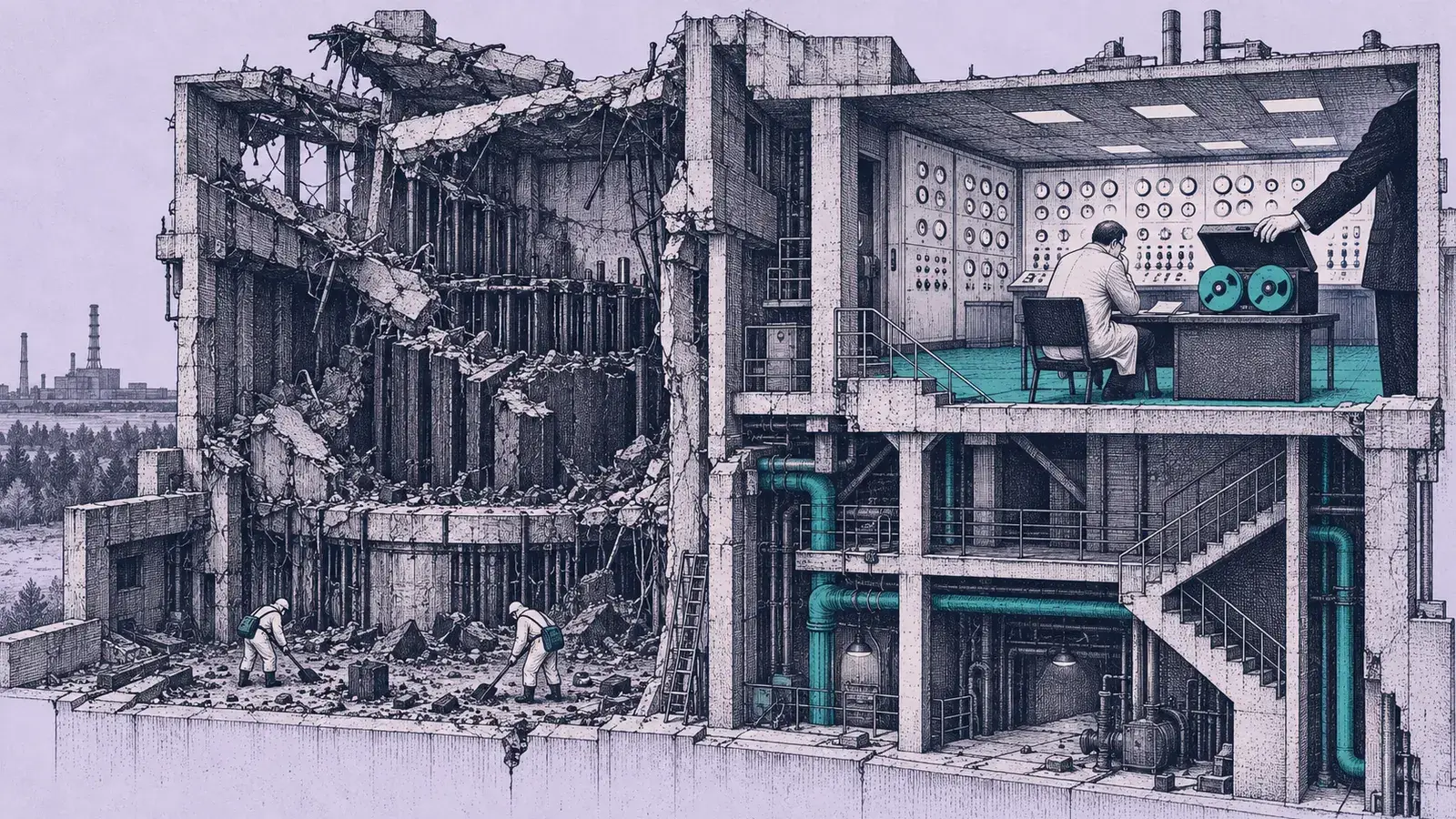
“Chernobyl” is a five-episode historical drama centered on the 1986 nuclear disaster and the cleanup efforts that followed. It was created and written by Craig Mazin, directed by Johan Renck, and stars Jared Harris, Stellan Skarsgård, Emily Watson and Paul Ritter. A co-production between HBO and Sky UK, it premiered on May 6 and 7, 2019, in the US and Britain respectively.
The series dramatizes the story of the April 1986 accident in the Soviet Union’s Ukrainian SSR, telling the stories of the people involved in and responding to the disaster. It depicts lesser-known aspects, such as the efforts of the firefighters who were first on the scene, volunteers and teams of miners who dug a crucial tunnel beneath reactor 4. It draws heavily on the recollections of Pripyat residents, as recorded by Nobel Prize-winning Belarusian writer Svetlana Alexievich in her book “Voices from Chernobyl.” Researchers have, however, documented that Alexievich inserts her own words into interviewees’ testimonies and revises them extensively, suggesting that her work should not be treated as a verbatim oral history.
Jared Harris plays Valery Legasov, the deputy director of the Kurchatov Institute who was called in to help with the cleanup, while Stellan Skarsgård plays Boris Shcherbina, a deputy chairman of the Council of Ministers. Emily Watson plays Ulana Khomyuk, a nuclear physicist from Minsk — a fictional composite character who, according to the actress herself, represents the many scientists who worked fearlessly and put themselves at great risk. Paul Ritter plays Anatoly Dyatlov, the plant’s deputy chief engineer, and Jessie Buckley plays Lyudmilla Ignatenko, the wife of firefighter Vasily Ignatenko.
Mazin began researching the project in 2014, reading books and government reports from inside and outside the Soviet Union, and speaking with nuclear scientists to understand how a reactor works. As he explained, the story truly came alive through the personal accounts of the people who were there. His inspirations included a desire to write something about “how we struggle with the global war on truth,” as well as the realization that he did not know why Chernobyl exploded. “The lesson of Chernobyl is not that modern nuclear power is dangerous,” he said. “The lesson is that lying, arrogance and the suppression of criticism are dangerous.”
The production decided early on against using Russian or Ukrainian accents, with Mazin explaining that “the actors act the accents” rather than the characters. Filming began in April 2018 in Lithuania: the Fabijoniškės district of Vilnius was used to portray Pripyat because it retains an authentic Soviet atmosphere, while the decommissioned Ignalina nuclear power plant in Visaginas — called “Chernobyl’s sister” because it uses the same RBMK reactor design — provided the setting for the plant’s exterior and interior shots. The series had a budget of approximately $40 million.
The soundtrack was composed by Iceland’s Hildur Guðnadóttir. In August 2018, she began recording inside the Ignalina plant with Chris Watson, deciding against relying on instruments and prerecorded material because she wanted to convey the experience of actually being inside a nuclear power plant.
The series was praised in the media as exhaustively researched, but commentators pointed out inaccuracies and artistic liberties. Legasov was not present at the trial, and he actually died by suicide one day later than shown in the first episode. The “Bridge of Death,” from which Pripyat spectators watched the aftermath of the explosion, is presented as a location whose spectators later died, a claim now considered an urban myth. The potential third steam explosion with a yield of two to four megatons was physically impossible under the circumstances; the physicists consulted by the production could not confirm its plausibility. On the other hand, the production design — sets, props and costumes — was praised for its accuracy, with a review in The New Yorker stating that “the material culture of the Soviet Union is reproduced with an accuracy never seen before.”
There was also criticism of the portrayal of Soviet officials. Chernobyl engineer Oleksiy Breus argued that the characters of Viktor Bryukhanov, Nikolai Fomin and Anatoly Dyatlov were “distorted,” portrayed as villains, while some reviews noted that the series creates a stark moral divide, with the scientists excessively heroic. Lyudmilla Ignatenko, whose story the series tells, said in a BBC interview that she had suffered harassment and had never given HBO permission to tell her story; HBO and Sky responded that they had been in contact with her before, during and after filming, and that she had never expressed a wish to be excluded.
The series received widespread acclaim: it has a 95% approval rating on Rotten Tomatoes, with an average rating of 8.9/10, and a score of 82 out of 100 on Metacritic, indicating “universal acclaim.” Critics from The Atlantic, The Washington Post and the BBC identified parallels with contemporary society, focusing on the power of information and how dishonest leaders can make mistakes beyond their understanding. At the 71st Emmy Awards, it received 19 nominations and won for Outstanding Limited Series, Directing and Writing, while also winning the Golden Globe for Best Miniseries and BAFTA awards.
In Russia, Culture Minister Vladimir Medinsky, whose father was a liquidator, called it “masterfully made,” but the Communists of Russia party called for a criminal prosecution for defamation. In Ukraine, the deputy director of the Ukrainian National Chernobyl Museum in Kyiv said it was a necessary film for young people unfamiliar with the disaster, while Alexievich noted that Belarusians had “completely changed their perception” of the tragedy thanks to the series. In China, when users linked the Soviet authorities’ response to the Chinese government’s initial handling of the COVID-19 pandemic, the series’ Douban page was taken down. Each episode was accompanied by a podcast in which Mazin and NPR host Peter Sagal discussed where the series remained faithful to the facts and where it took artistic liberties.

Comments