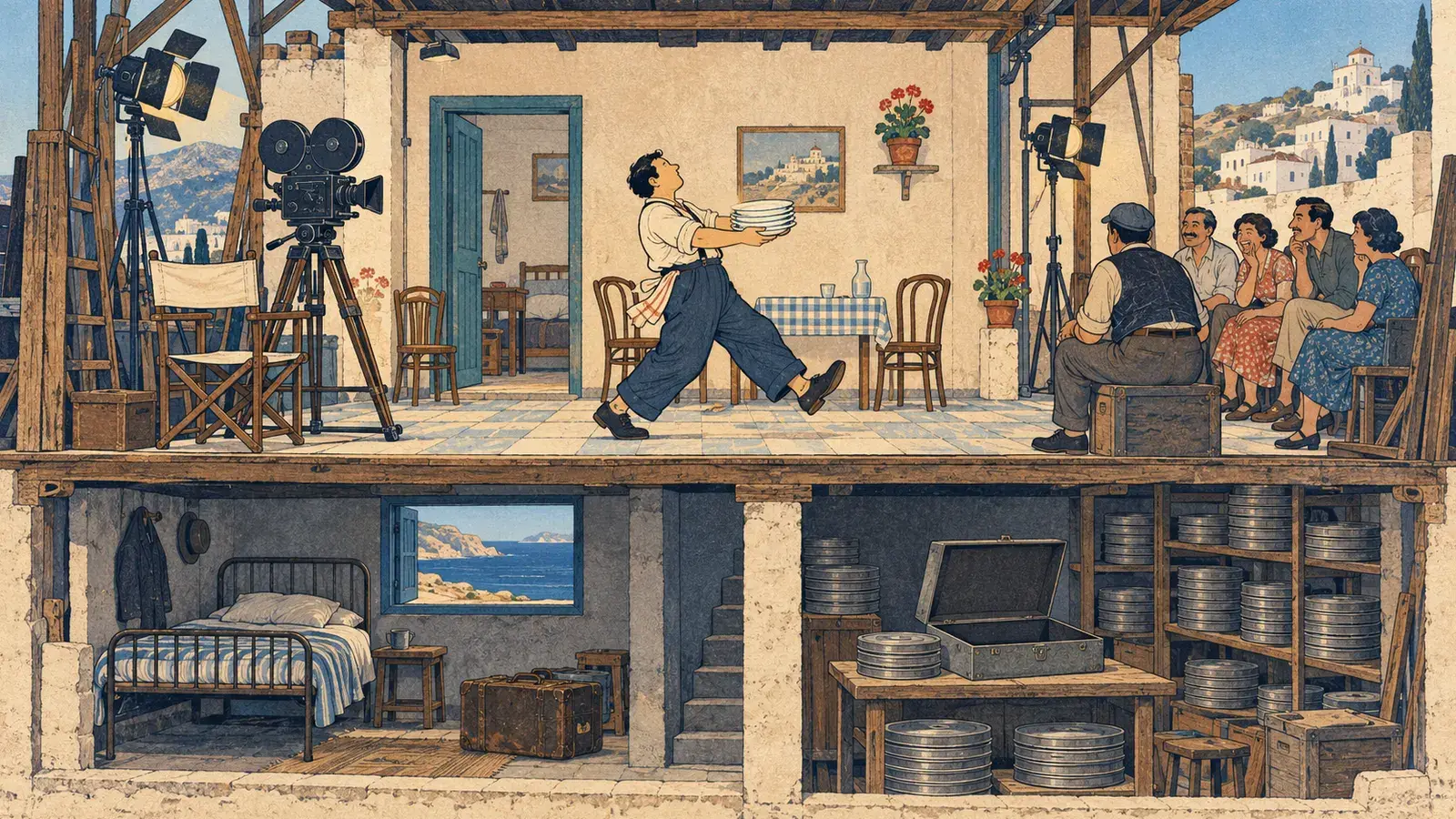
Thanasis Veggos, known as “our good man,” was one of Greek cinema’s most popular comedians. He appeared in 126 films, taking the lead role in 52 of them, and directed another seven, continuing to appear in films, television and theater until the end of his life. His real surname was Vegkos, which he spelled with “gg” when he became an actor because, as he said, it looked better.
He was born in Neo Faliro on May 29, 1927, the only son of Vasilis and Evdokia Vegkos, with roots in Tholaria on Amorgos. His father, a resistance hero, was dismissed from his job after the war because of his political beliefs, plunging the family into financial hardship. Thanasis had to work from an early age, mainly in leather processing, while also running small errands in the neighborhood.
From 1948 to 1950, he completed his military service as an “undesirable” soldier on Makronisos. There he met director Nikos Koundouros, an acquaintance that led to his first film appearance in 1954 in Magic City. Over the next five years, he played small roles and worked as a props assistant on film sets, appearing in landmark films such as The Dragon, Madalena and Never on Sunday. His first major role came in 1959 in The Wandering Jews, while that same year he received a professional acting license as an exceptional talent and made his theatrical debut in the revue Omonia Splash-Splash.
Working mainly with Panos Glykofrydis, he developed the nervous, constantly moving hero who made his name, in films such as Hands Up, Hitler, Have You Seen Panai? and Long Live Madness! In 1964, seeking artistic freedom, he founded the production company ThV–Laughter Films. Between 1965 and 1969, he made what are widely considered his best films, including Help! Veggos, Overt Agent 000 and Crazy, Mad and Veggos, characterized by surreal humor, improvisation and spontaneous performances. However, despite their commercial and artistic success, these films led to the closure of his company and his own financial ruin, from which he recovered only after many years.
His career continued with Dinos Katsouridis, while his popularity remained steady and led to an enthusiastic reception from the public at the 1971 Thessaloniki Film Festival, when What Did You Do in the War, Thanasis? won critics’ and audience awards. His subject matter gradually shifted toward social criticism. In the 1980s, he worked on six video films and the television series Veggalika, which was eventually broadcast in 1988, while in 1990 he appeared in the ANT1 series Police Officer Thanasis Papathanasis.
He returned to cinema in 1991 with Pantelis Voulgaris’ Quiet Days in August. His performances were now understated but highly expressive, with his role in the 1998 film All Is a Road marking a high point. He also appeared at Epidaurus in 1997 as Dikaiopolis in The Acharnians and in 2001 in Aristophanes’ Peace. In 2000, he appeared in the television series Of Winds and Waters, while his final film appearance was in The Flight of the Swan in 2010.
He married Asimina (Mina) Karydi on December 16, 1956, and they had two sons, Vasilis (1959) and Haris (1965). According to his elder son, Veggos felt “like a fish out of water” in artistic circles, despite his friendships with colleagues such as Panos Glykofrydis and Dinos Katsouridis.
The final years of his life were marked by health problems: prostate surgery in 2004, two mild strokes, aneurysm surgery in 2010 with complications, and finally a severe stroke in December 2010 that caused a fall, which resulted in a brain hematoma. He died on May 3, 2011, at the age of 83, from multiple organ failure and septic shock. His body lay in state at the Church of Saint Marina in Thiseio, with officials, friends and members of the public in attendance.
In accordance with his wishes, he was not buried, and it became known only in July 2024 that he had been cremated, as had his wife Asimina, who died quietly in 2023. Veggos also appeared on two songs — I Said It, I Did It by Foivos Delivorias (1995) and The Ballad of Garbage by Nikos Kypourgos (2001) — while books have been written about his life and work, including A Man for All Seasons by Giannis Soldatos.




Comments