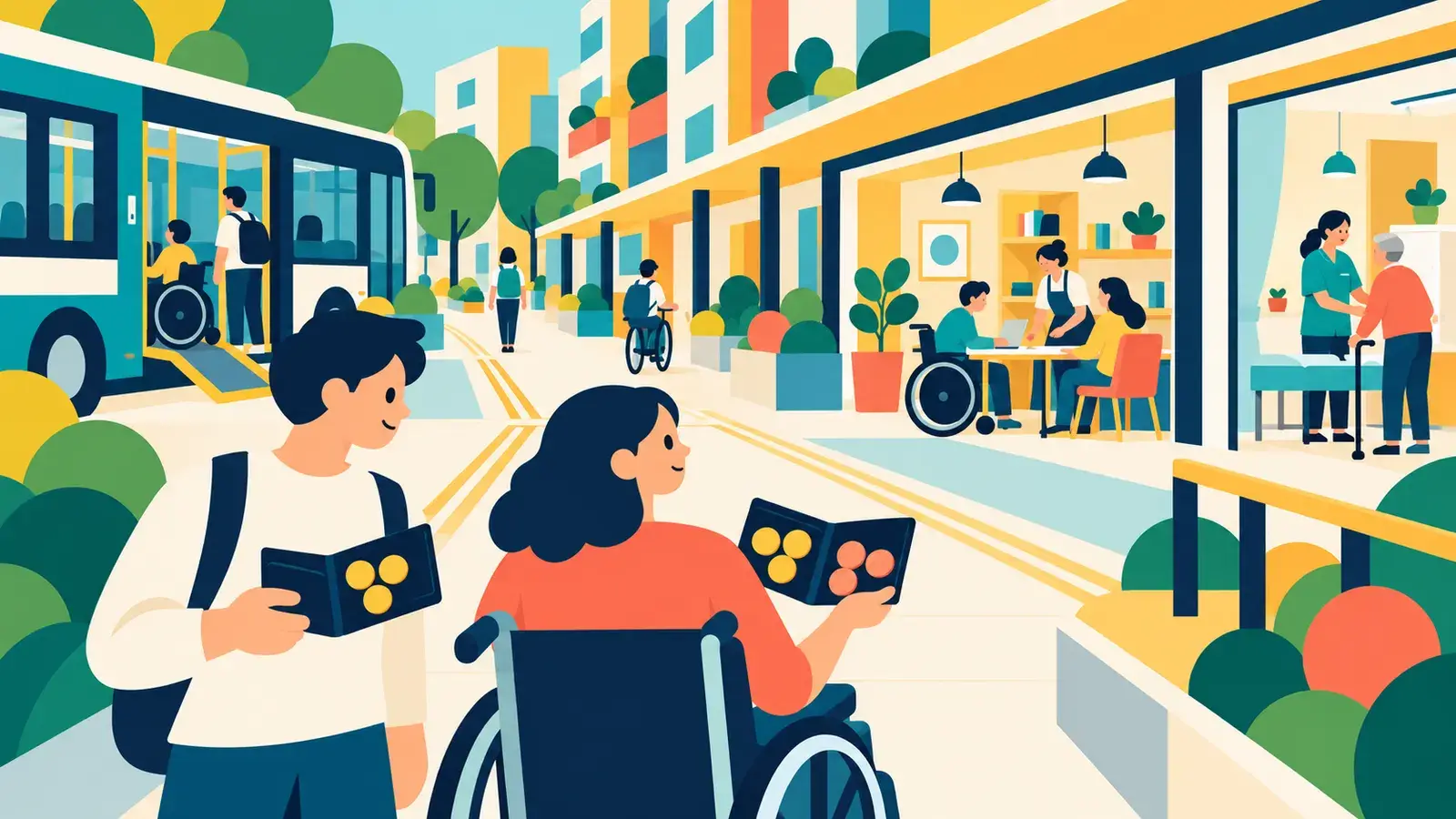
At the annual congress of the Basic Income Earth Network (BIEN) in 2026, the Taiwan UBI Forum raised a question that often remains on the margins of the discussion about unconditional basic income: is an equal amount for everyone enough, or do people with disabilities need additional income and services? Researcher Wu Zhiwei presented relevant research and proposed a “three-tier approach”, which seeks to combine the universality of basic income with personalised support.
The research starts from the premise that basic income has significant value because it creates a common income foundation without work requirements or means tests. However, when everyone receives the same amount, actual living conditions may differ considerably. For people with disabilities, everyday life often involves additional expenses: limited transport accessibility, a need for assistive devices, personal assistance, medical care and environmental barriers. The same amount of money therefore does not necessarily translate into the same quality of life or the same opportunities for social participation.
According to the research, the policy’s goal should not be limited to basic survival. It should examine how institutional and environmental barriers can be reduced so that people with disabilities can participate meaningfully in education, work, community life and public activities, while retaining choice and autonomy over how they live.
Compared with traditional welfare systems based on strict requirements and checks, universal basic income is simpler and more accessible, and can reduce the stigma and administrative burden of some applications. However, if the different additional needs of people with disabilities are taken into account, the policy must answer the question of how to provide differentiated support. Additional cash offers flexibility because it allows individuals to decide where to use it; if the amount depends on individual needs, however, some form of assessment is required.
Disability is extremely diverse, and support needs may change with time, environment and stage of life. If categories become too detailed, administrative complexity and the burden of applying increase. The research therefore sees balancing personalised support with the avoidance of excessive bureaucracy as a central concern.
The “three-tier approach” proposed by Wu Zhiwei consists of three complementary parts. The first tier is the “common floor”: an equal basic income for everyone, serving as minimum financial security and a guarantee of dignity, regardless of income, employment or other circumstances. The second tier concerns additional cash support for the extra costs arising from disability, limitations and the environment, so that individuals can use resources according to their own needs. The third tier includes public services and support resources, such as personal assistance, assistive devices, accessible surroundings and other necessary professional services. The three tiers do not replace one another: universal basic income provides a common financial foundation, additional cash addresses individual differences in costs, and public services meet needs that are difficult to address through the market or purchasing power alone.
When adequate services are available in the market, information is transparent and access is possible, additional cash strengthens flexibility and personal choice. By contrast, the state needs to maintain steady investment in professional care, accessible public infrastructure and personal assistance.
The research concludes that the equality sought by basic income should not be limited to an equal amount for everyone. It is necessary to examine whether different groups gain substantially similar choices in life and opportunities for social participation. For people with disabilities, basic income can serve as a common financial safety net, but additional cash, personal assistance, assistive devices and accessible public surroundings remain essential.
The Taiwan UBI Forum seeks to place disability policy at the heart of basic income design, exploring how a cash guarantee and public services can be combined into a social safety net that respects universality, individual autonomy and substantive equality. It also announced the organisation of the 2027 Indo-Pacific Basic Income Summit, where discussions will cover basic income, artificial intelligence and the future of work, young people’s economic security and the future of social protection.




Comments