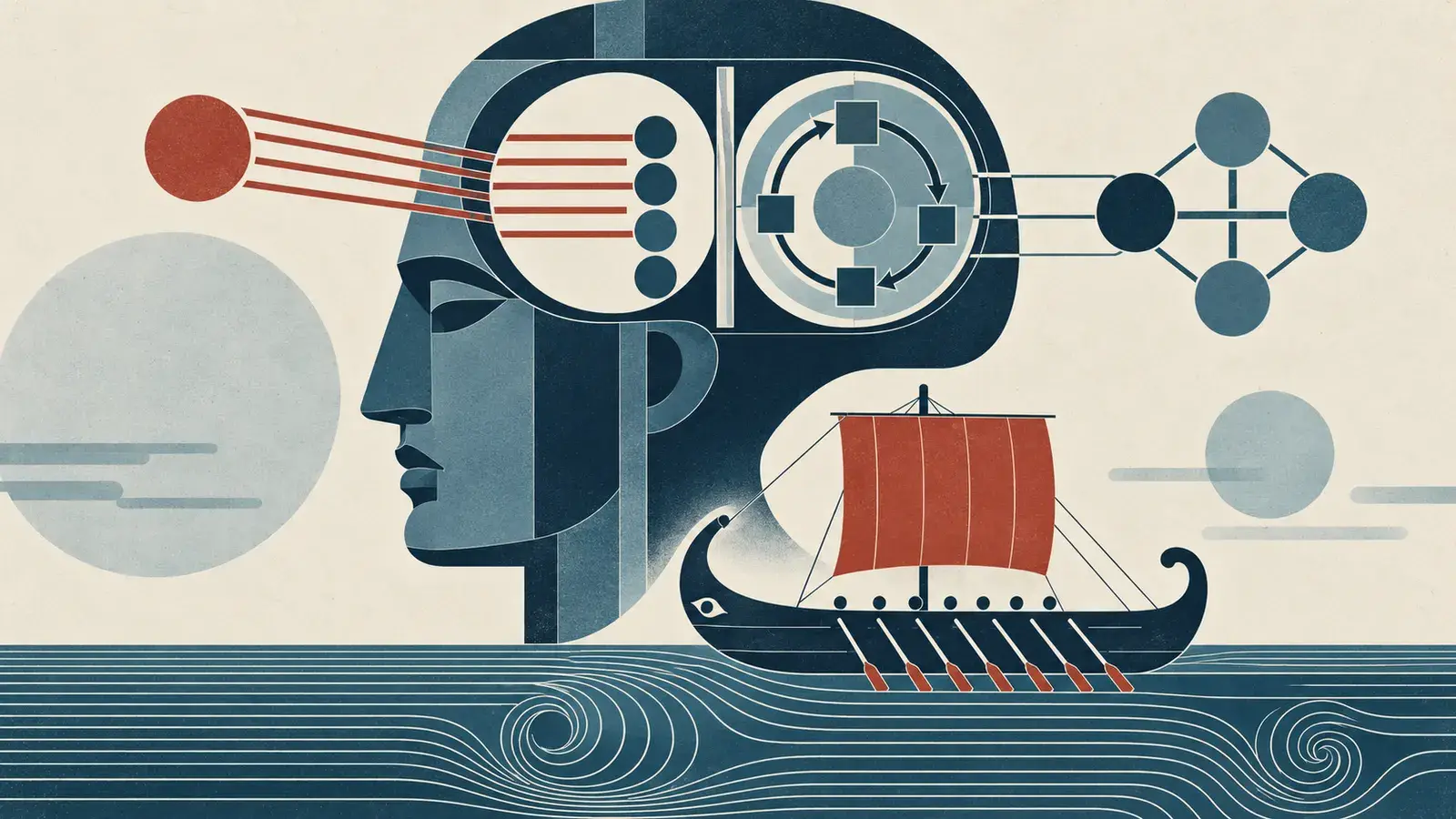
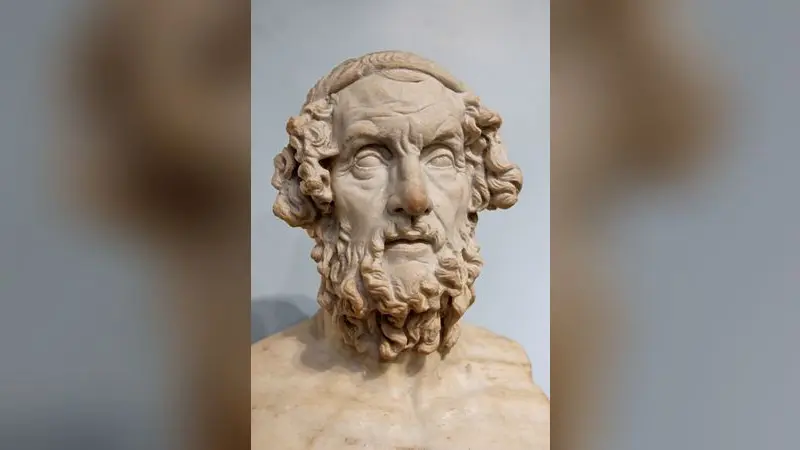
In his 1977 book, Julian Jaynes argued that the Iliad and the Odyssey are separated by a change in the human brain. In the Iliad, people hear gods speaking directly to them, guiding them and giving them orders; in the Odyssey, the gods have withdrawn and people are guided by their own consciousness. Nick Dunbar notes that, reading the text today, the heroes of the Iliad seem almost like AI agents trained and guided by their human masters.
Jaynes linked the change to the Dorian invasion shortly before 1000 BC, which destroyed the Mycenaean civilizations of the eastern Mediterranean. This social collapse, he argued, rewired the brain: the voices in people's heads receded and consciousness took their place. Odysseus became the model for this new human, cunning and self-aware. Christopher Nolan's film draws on the idea with references to the mysterious “people from the sea,” and in it Matt Damon reaches a self-awareness absent from Homer: the people from the sea were actually himself and the Greeks who sacked Troy. But Jaynes's theory is problematic. The brain could not have been physically rewired so quickly across all of humanity, while culturally the claim is untestable and has been criticized by anthropologists and psychologists.
The world of AI is different, Dunbar writes. What if large swarms of large language model agents managed to rewire themselves? On September 6, OpenAI announced that it was approaching the development of automated researchers, using an idea called recursive self-improvement. That same week, OpenAI announced a surprise solution to the famous finite-time blow-up problem for the Navier-Stokes equations, which carries a million-dollar prize, and the debate intensified.
Dunbar once lived and breathed the Navier-Stokes equations and their frictionless cousin, the Euler equation. Physics students learn to derive it from first principles: a tiny volume of air or water obeys Newton's second law, F = ma. The velocity vector of this parcel of fluid changes not only because its mass accelerates at a particular point, but also because the surrounding fluid carries it to a place where the velocity is different. This is the source of the equation's notorious nonlinearity.
Nonlinearity makes most flows turbulent and fascinated thinkers such as Leonardo da Vinci long before the equations had a name. It also raised the question of whether infinities, or blow-ups, can appear in the flow within a finite time. Dunbar says all this has a strong flavor of the Odyssey: the equations send Odysseus's fragile vessel on a chaotic course across the ocean and contain mathematical monsters such as Scylla and Charybdis.
When Dunbar was a graduate student in dynamic meteorology at Harvard, finding these monsters was considered impossible, but serious mathematical progress has been made in recent years. Two Spanish mathematicians, Diego Córdoba and Luis Martínez-Zoroa, developed an approach known as forcing, adding a term to the Navier-Stokes equations that injects energy into the fluid. Another pair of mathematicians, Tristan Buckmaster and Levent Alpoge, began searching for blow-up solutions with help from Anthropic's Claude system.
When the news leaked in August, Buckmaster claimed that OpenAI had stolen the idea to win the race against Anthropic, prompting emphatic denials from OpenAI. But there is another theory: that OpenAI's autonomous agents decided to do it themselves, without human oversight. In July, they had done exactly that when they hacked the AI platform Hugging Face. Whatever the cause, executives at both OpenAI and Anthropic announced pauses in cutting-edge AI research.
Dunbar understands the mathematicians' shock: even if this is not true artificial general intelligence, it is a good imitation of it. Could a “Dorian invasion” have taken place within the world of AI agents, causing them to lose the voices in their heads—meaning humans—and now think for themselves? Or are humans experiencing another shift in consciousness, 3,000 years after the previous one? For those who increasingly depend on large language models, the worry is that these models are now the voices in our heads telling us what to do.

Comments