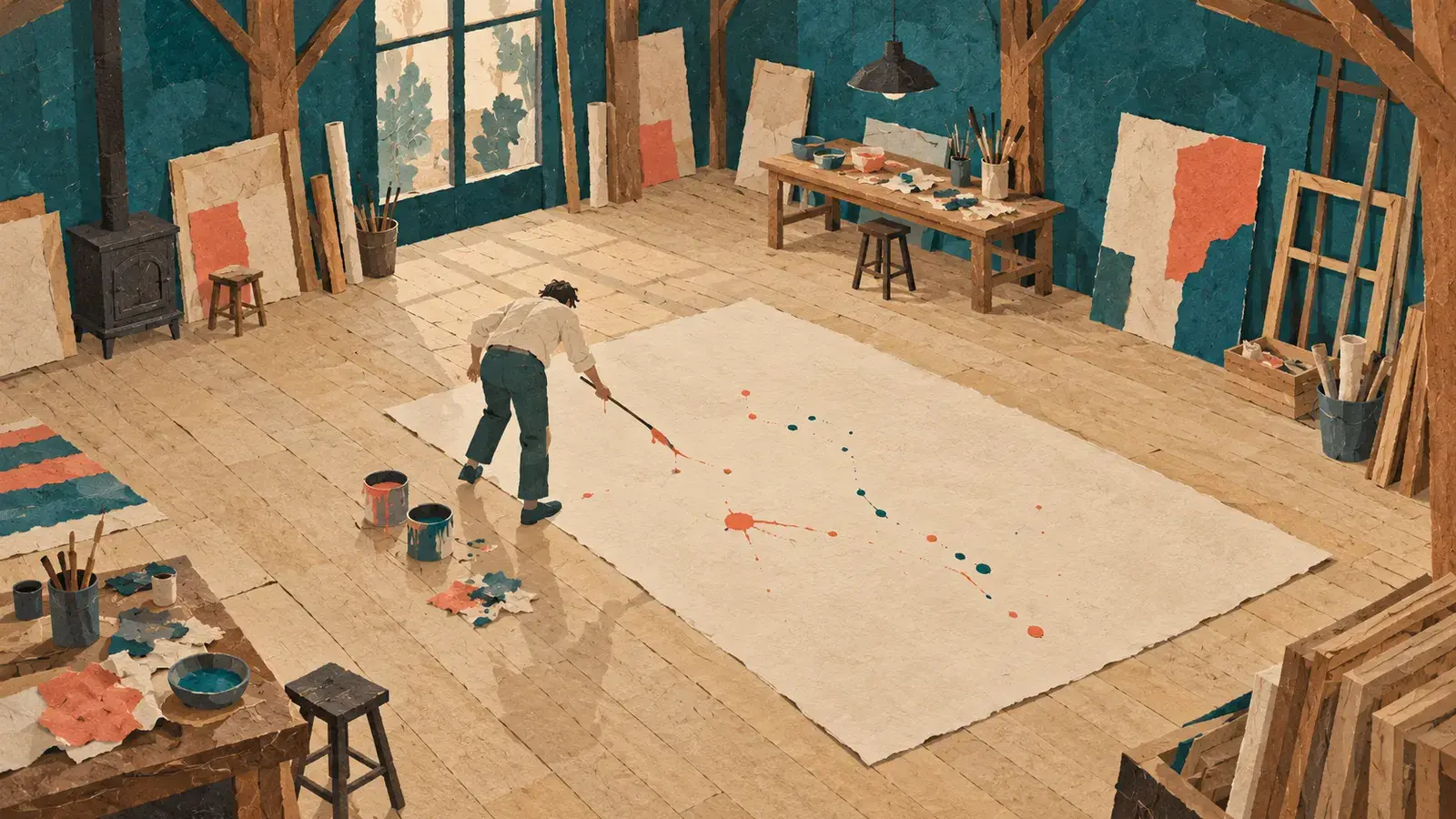
The American painter Jackson Pollock (Jackson Pollock) (Jackson Pollock, 1912–1956) was a central figure in abstract expressionism, known for his technique of dripping, pouring or flinging liquid paint onto canvases laid horizontally. Working from all sides, he made bodily movement part of the creative process and covered the entire painting surface. His work provoked strong reactions: some critics recognised the immediacy of the process, while others saw disordered, random results. His influence continued after his early death, both in painting and in art forms that emphasised the creative process.
He was born in Cody, Wyoming, on 28 January 1912, the youngest of five brothers, and grew up mainly in Arizona and California. The family’s moves were linked to his father’s work, first as a farmer and later as a government surveyor. Accompanying him on surveying jobs brought Pollock into contact with Native American cultures. In 1930, he followed his older brother to New York and studied at the Art Students League under Thomas Hart Benton (Thomas Hart Benton), whose influence lay more in the rhythm of his painting than in its subject matter.
Mexican muralists played an important role in his artistic development, particularly José Clemente Orozco (José Clemente Orozco). In 1936, at an experimental workshop run by David Alfaro Siqueiros (David Alfaro Siqueiros), he was introduced to the use of liquid paints, which he later employed in his paintings. From 1938 to 1942, he worked for the WPA Federal Art Project while also trying to address his alcoholism through Jungian psychotherapy. As part of his treatment, he was encouraged to draw, and concepts and archetypes from Jungian psychology appeared in his painting.
In 1943, he signed a contract with Peggy Guggenheim (Peggy Guggenheim), who commissioned the large work Mural for the entrance to her home. The commission and the gallery’s support helped establish his reputation. In 1945, he married the painter Lee Krasner (Lee Krasner), and the couple settled in Springs on Long Island, where he converted a barn into a studio. Krasner, with her extensive knowledge of modern art, was an important sounding board for his work and introduced him to collectors, critics and artists. Critics reassessed her contribution to his career particularly from the late 1960s onwards.
In his Springs studio, he developed his drip technique, using synthetic household paints, hardened brushes, sticks and other tools. Having the canvas on the floor allowed him to walk around it and feel, as he explained, part of the painting. Although the result could look random, he denied that it relied on accident: he combined controlled movements with the flow of paint, gravity and absorption by the canvas. His method became associated with action painting, in which gesture and the act of creation take on central importance.
His best-known paintings were made between 1947 and 1950, and a LIFE article in 1949 brought him wider fame. His technique had multiple influences, from Mexican muralists and Surrealist automatism to the painter Janet Sobel (Janet Sobel), whose work he acknowledged had impressed him. His own explanations of the method’s origins were not always consistent, particularly regarding its connection with Siqueiros. At the same time, he began replacing descriptive titles with numbers, aiming to have viewers look at the paintings without a predetermined subject.
Critical debate over his work remained divided. Clement Greenberg (Clement Greenberg) championed it as a major achievement in modern painting, while other critics dismissed the compositions as meaningless bursts of energy. His international exposure also took on a political dimension, as the CIA-backed Congress for Cultural Freedom funded exhibitions of his work. Some scholars interpreted this promotion as a use of abstract expressionism in the cultural confrontation of the Cold War.
After 1951, Pollock turned to darker compositions, including works in black paint on unprimed canvas, seeking a balance between abstraction and the human figure. He later reintroduced colour, but the pressure of demand and personal disappointment were accompanied by worsening alcoholism. He painted his final two paintings in 1955, while in 1956 his relationship with Krasner was shaken by his continuing alcoholism and infidelity. On 11 August 1956, driving under the influence of alcohol, he was killed in a car crash at the age of 44. His passenger Edith Metzger (Edith Metzger) also died in the crash, while Ruth Kligman (Ruth Kligman) survived.
Krasner managed his artistic legacy for the rest of her life. The Museum of Modern Art organised a retrospective a few months after his death and a larger exhibition in 1967, while further major retrospectives followed in 1998 and 1999 in New York and London. Later painters drew on his coverage of the entire surface and his use of paint on raw canvas. Artists in other fields were influenced mainly by his emphasis on the process itself, beyond the appearance of the finished work.
The study of his work also extended into science, particularly questions of authenticity. In 1999, the physicist and artist Richard Taylor (Richard Taylor) identified similarities between his painted patterns and fractals, structures that repeat at different scales. This analysis was used on disputed paintings. Meanwhile, pigment analyses revealed materials dating from after his death in some works attributed to him. These disagreements show why mathematical patterns need to be considered alongside the materials and documented history of each painting.




Comments