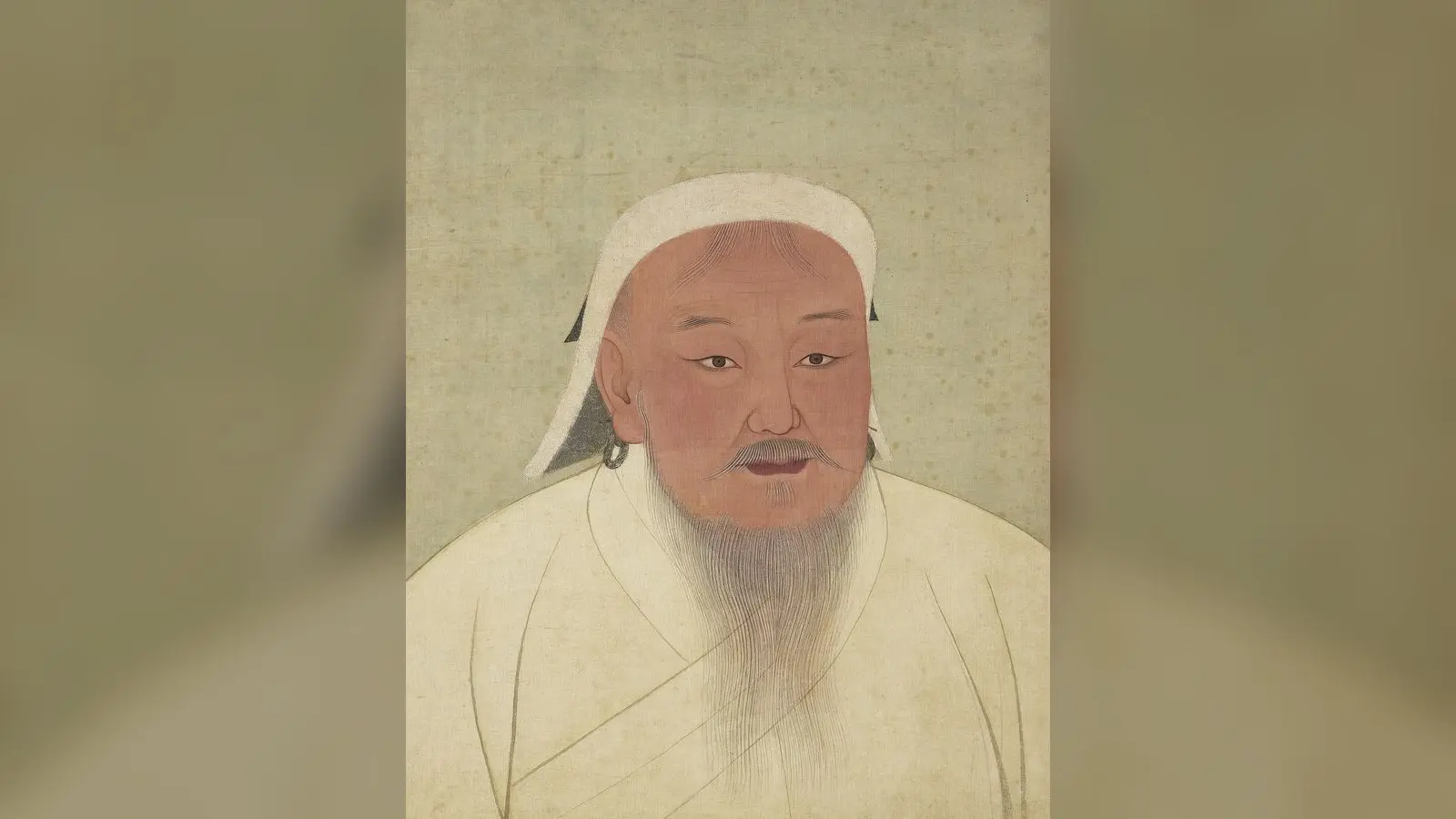
Genghis Khan was born as Temujin, most likely in 1162 (although 1155 and 1167 are also cited), the son of Yesugei, chief of the Borjigin tribe. When he was eight, his father was poisoned by Tatars and his family was abandoned by its tribe, living on the edge of poverty by hunting and gathering roots. To consolidate his position, Temujin killed his older half-brother Bekhter.
Despite these hardships, his charismatic personality attracted his first followers and allies, such as Jamukha and Toghrul, with whom he recovered his wife Börte after she had been abducted. His relationship with Jamukha developed into open warfare.
Around 1187, Temujin suffered a heavy defeat at the Battle of Dalan Baljut and may have spent years as a subject or servant of the Jin dynasty in northern China. He reappeared in 1196, taking part in a Jin campaign against the Tatars, for which he received the honorary title "cha-ut kuri", roughly meaning "commander of hundreds". This radically changed his position on the steppe: from being nominally subordinate to Toghrul, he became an equal ally in practice.
In the following years, Temujin subdued the Jurkin, Taichiud and Tatar tribes, executing their leaders and absorbing their warriors into his forces. The conflict with the Kereites came to a head in 1203, when Toghrul attempted to ambush him; although defeated at the Battle of Qalaqaljit Sands, Temujin regrouped, swore the famous Baljuna Covenant with a diverse group of loyal followers (Christians, Muslims and Buddhists), and defeated the Kereites through a ruse. In 1204, he crushed the Naiman at the Battle of Chakirmaut and executed his childhood ally Jamukha, becoming the sole ruler of the Mongolian steppe.
In 1206, at a great assembly (kurultai) at the headwaters of the Onon River, he adopted the title "Genghis Khan", whose meaning is uncertain—one theory links it to the word "ocean" and thus to "universal ruler". A "social revolution" followed: he reorganised society into a decimal military system (units of ten, one hundred and one thousand), breaking down tribal identities and imposing a merit-based system founded on loyalty to the Khan. The imperial guard (keshig) expanded to 10,000 men and served as a military academy and administrative centre. He also faced an attempted coup by the shaman Kokochu, which he suppressed.
From 1209, he launched major campaigns: he raided Western Xia, subduing it by 1210, and then attacked the Jin dynasty, capturing its capital, Zhongdu, in 1215. His general Jebe annexed the state of Qara Khitai in 1218. In 1219, after his envoys were executed, Genghis invaded the Khwarazmian Empire, overthrew it and devastated the regions of Transoxiana and Khorasan, while Jebe and Subutai reached as far as Georgia and Kievan Rus'.
He died in 1227 while suppressing a rebellion in Western Xia. After a two-year interregnum, his third son, Ögedei, ascended the throne in 1229.
Genghis Khan remains a controversial figure: he was generous and exceptionally loyal to his followers, but merciless towards his enemies, believing that the god Tengri had destined him to rule the world. The Mongol army killed millions of people, yet the conquests facilitated unprecedented trade and cultural exchange across a vast geographical area.
How he is remembered varies by region: in Russia and the Arab world, he is considered a barbaric and bloodthirsty tyrant, while Western historiography has been reassessing the earlier image of him as merely a barbarian warlord since the 1990s. In Mongolia, he was glorified after his death and is recognised as the founder of the nation.
The sources are numerous and often contradictory; The Secret History of the Mongols stands out because, unlike official chronicles, it openly criticises the Khan for killing his brother and for other taboo acts.




Comments