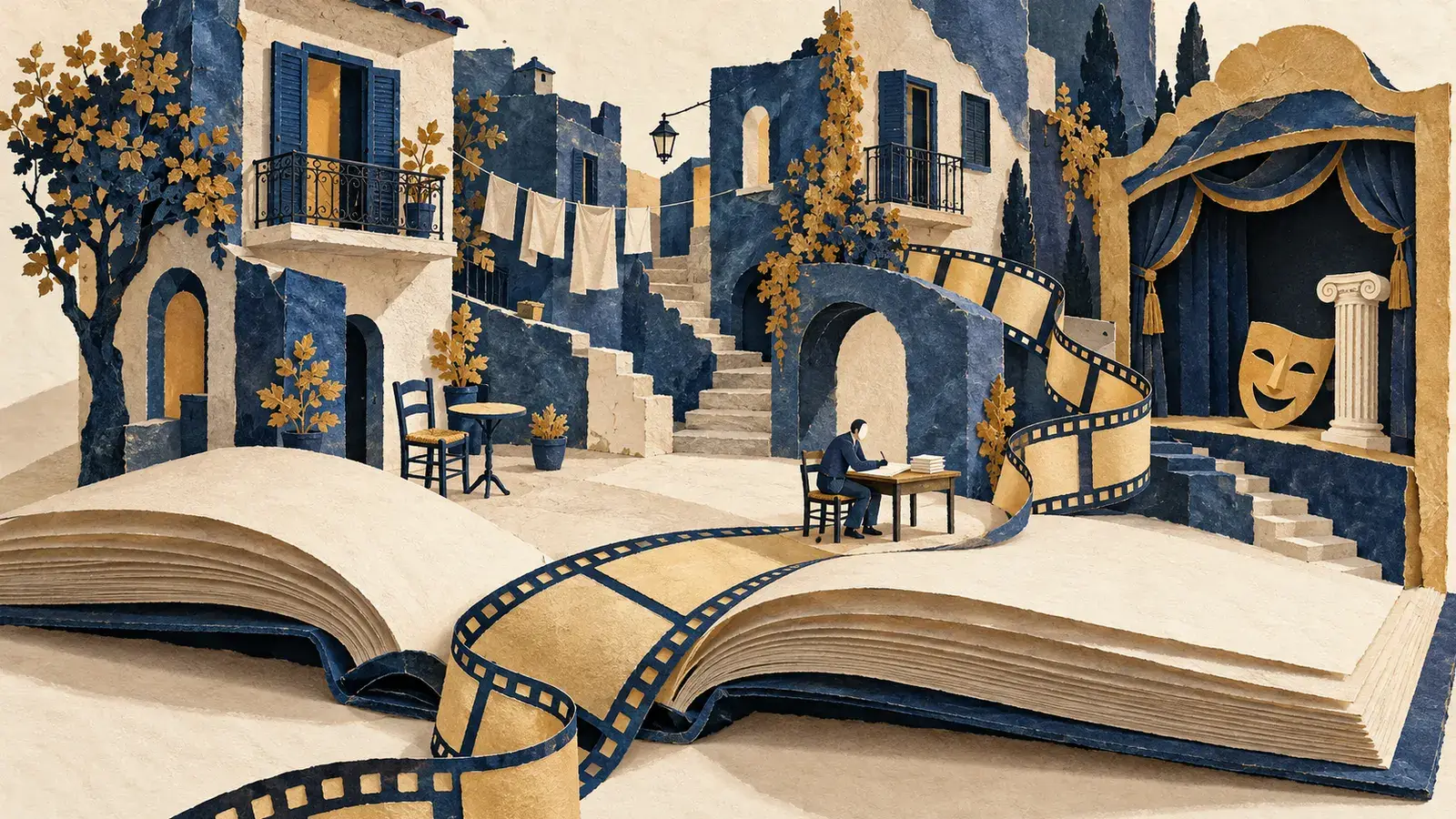
Nikos Tsiforos was a Greek writer, journalist, screenwriter and director whose work appeared in newspapers, magazines, theatres and cinemas. He wrote more than 40 plays and over 60 screenplays, sometimes alone and sometimes with collaborators, chiefly Polyvios Vasileiadis. Humour, characters from the margins of Athens society and a satirical approach to historical and mythological subjects are central features of his writing.
He was born in Alexandria, Egypt, on 27 August, but the two supplied entries disagree on the year: the Greek entry gives 1909 and the English one 1912. His father was a businessman from an old family in Limni, Evia. According to both versions of his biography, the family settled permanently in Athens two years after his birth.
He began writing at the age of eleven and made an early attempt to bring his work to the stage. The Greek text dates his first revue to 1928, at an open-air theatre in Freattyda, and says the attempt failed; the English text dates his first theatrical attempt to 1938. He studied law and, according to the Greek entry, worked for two years at the Court of Audit before resigning to go to sea. Until 1939, he moved between jobs while continuing to write and publish in newspapers and magazines.
His first major theatrical success came in 1944, when Mary Aroni and Dimitris Horn’s company staged “The gallery of fools” at the Acropol Theatre. In the late 1940s, he also moved into cinema, writing and directing “Last mission”, which was released in 1949. His later work as a director included films such as “Come to uncle”, “The belle of Athens”, “The dead man’s treasure” and “Klearchos, Marina and the short man”.
Journalism remained a regular part of his work. He contributed to newspapers such as Proodeftikos Fileleftheros, To Vima and Eleftheros Kosmos, as well as the magazines Trust, Romantso, Tachydromos and Pantheon. He wrote columns on everyday life and humorous sketches, often using pseudonyms. Many of his works first appeared in instalments, directly linking his writing career to the periodical press of the time.
His stories often feature people on the margins of prewar and postwar Athens who have dealings with the law. According to the Greek entry’s description, dramatic situations are exaggerated until they become grotesque. His works include “The streetwise boys”, published in Tachydromos in 1960–1961, and “Tales behind bars”, which followed in 1962–1963. The English entry also highlights his use of contemporary colloquial Greek, although it does not name the critics to whom it attributes this assessment.
Another part of his writing focused on history, mythology and religious narratives. “The Crusades” was serialised in 1958–1959, while “Greek mythology”, described in the biographical text as a parody, was published in 1963–1965. His works also include “Biblical smiles”, “Cruises through history” and “We and the Franks”. He also wrote histories of England, France, the United States and Athens, which first appeared in Pantheon during the 1960s.
His collaboration with Polyvios Vasileiadis is recorded in many plays and screenplays. Their joint film work includes “The cicada and the ant”, “The gentleman’s wife”, “My wife has gone mad” and “An Italian woman from Kypseli”. Tsiforos’s stories also provided material for other screenwriters: “Poor folk and rich folk”, with a screenplay by Orestis Laskos, was based on his story “Glove and sardine”. These different paths taken by his texts show the extent of his presence in Greek cinema.
He developed cancer in 1965 and continued writing during his illness, despite the operations and metastases mentioned in the Greek biography. He died in Athens on 6 August 1970 and is buried in Limni, Evia. “People and little people” was being published in Tachydromos in 1969–1970, during the final period of his life. For today’s readers, his work offers access to a satirical portrayal of Athens society and to ways of telling stories that connected everyday language with theatre, cinema and history.

Comments