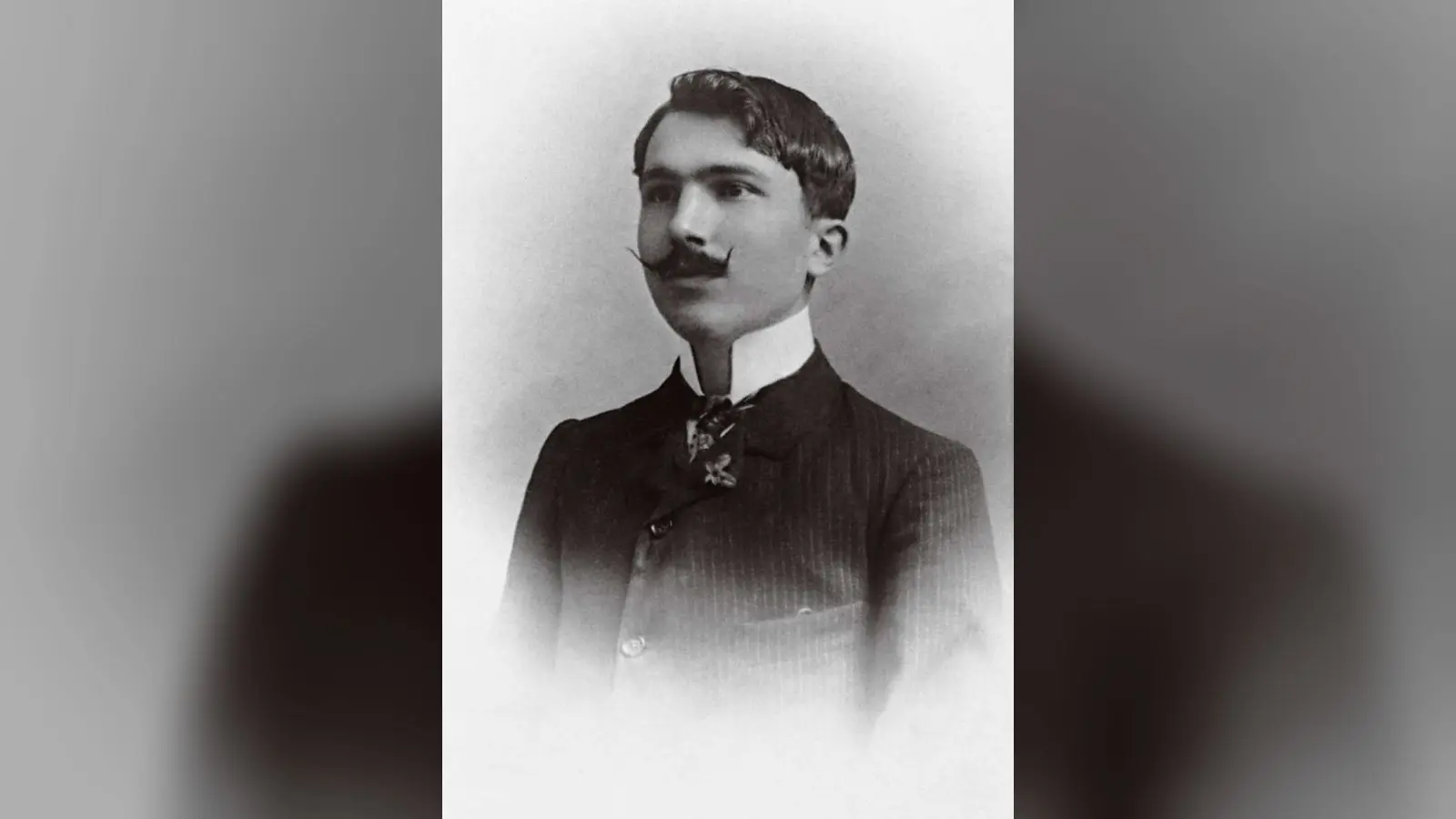
Nikos Kazantzakis was born in Heraklion, Crete, on 18 February or 2 March 1883, when the island was still part of the Ottoman Empire. He was the son of Michalis Kazantzakis, a merchant in agricultural produce and wine, and Maria Christodoulaki. When he was six, his father took him to the “Great Plane Tree” to kiss the feet of the community elders whom the Turks had hanged.
He attended the French Commercial School of the Holy Cross on Naxos, where he learned French and Italian, and in 1906 he was awarded a doctorate with distinction by the University of Athens Law School. His first appearance in Greek literature came in 1905 with translations of texts by Ernest Renan, Jean Paul and Dante, while friends printed his novella The Serpent and the Lily without his knowledge under the pen name Karma Nirvami. In Paris, he attended lectures by Henri Bergson, whom he later introduced to audiences in Athens, and published a dissertation on Friedrich Nietzsche.
In 1911, he married Galateia Alexiou. As president of the Heraklion Demoticists’ Association “Solomos,” he defended the use of demotic Greek in education, while during the First Balkan War he enlisted as a volunteer but was assigned to Eleftherios Venizelos’s office.
In 1914, he became friends with Angelos Sikelianos. Together they traveled to Mount Athos, where they stayed for around forty days, and toured many parts of Greece in search of “the consciousness of their land and people.” During this period, he encountered the work of Dante, whom he regarded as his teacher, alongside Homer and Bergson.
In 1919, Venizelos appointed him director general of the Ministry of Relief, with the task of repatriating 150,000 Greeks from the Caucasus. His experiences of settling refugees later informed the novel Christ Recrucified, while his failed ventures trading timber from Mount Athos with I. Skordilis and operating a lignite mine in Mani with the worker Giorgis Zorbas became raw material for Zorba the Greek.
Kazantzakis traveled to many parts of Europe, the Soviet Union, Palestine, Cyprus, Japan and China. In Vienna in 1922, he became acquainted with Sigmund Freud’s work and Buddhist texts.
In the 1920s, he was a leftist: he interviewed Primo de Rivera and Benito Mussolini, and in 1925 he was arrested in Heraklion because he was considered the intellectual leader of a communist organization of discontented refugees, but was released after twenty-four hours. In 1927, he went to Moscow for the tenth anniversary of the October Revolution and met Panait Istrati. In 1928, they spoke together in Athens, praising the Soviet Union, which led to a prosecution, but the trial never took place. In 1930, he was due to stand trial again for atheism because of The Saviors of God, but that trial did not take place either.
In the 1930s, he settled on Aegina, wrote a French–Greek dictionary and translated Dante’s Divine Comedy. In 1938, after thirteen years, seven drafts and around 15,000 hours of work, his magnum opus, The Odyssey, was published: 33,333 lines of seventeen syllables each in 24 rhapsodies, with around 7,500 words not recorded in dictionaries. It was the first Greek book published using the monotonic accent system, 44 years before its official adoption.
During the Occupation, despite the privations, he completed Zorba, the second draft of Buddha, Prometheus, Kapodistrias and Constantine Palaiologos, while collaborating with Ioannis Kakridis on a translation of the Iliad.
After the Liberation, he became politically active: he took over the presidency of the Socialist Workers’ Movement and served as a minister without portfolio in Themistoklis Sofoulis’s government from November 1945 to January 1946. In 1945, he fell two votes short of election to the Academy of Athens.
He was nominated for the Nobel Prize in nine years between 1947 and 1957, with a total of fourteen separate nominations. In 1947, he was appointed to UNESCO to promote translations of classic works as a way of bridging cultures, but resigned in 1948 to devote himself to literature. He settled in Antibes, France, where he completed most of his prose works.
In 1953, he developed an eye infection and lost the sight in his right eye. He died in Freiburg on 26 October 1957, aged 74, following an illness attributed to leukemia or severe Asian influenza.
His relationship with the Church was fraught with conflict. As early as 1928, the bishop of Syros had condemned The Saviors of God. In 1954, following the publication of Captain Michalis and The Last Temptation, the Holy Synod considered excommunicating him. The Last Temptation was added to the Roman Catholic Church’s list of prohibited books, the Index Librorum Prohibitorum. Ultimately, the Church of Greece did not proceed with excommunication, as Ecumenical Patriarch Athenagoras opposed it and spiritual jurisdiction belonged to the Ecumenical Patriarchate.
After his death, the archbishop of Athens rejected a request for him to lie in state, and burial in a cemetery was forbidden. Kazantzakis was buried at the Martinengo Bastion on Heraklion’s Venetian walls, where the inscription he had chosen was engraved: “I hope for nothing, I fear nothing, I am free.”
His work has been translated into more than 50 languages and adapted for theater, cinema, radio and television. He is considered the writer who established travel literature in Greek letters, the first in Greece to write a history of Russian literature and one of the first Greek screenwriters.
Despite his international recognition, during his lifetime he was insulted, harassed and slandered to a degree experienced by very few modern Greek writers. Responding to threats of excommunication, he wrote: “You gave me a curse, Holy Fathers; I give you a blessing: I wish that your conscience may be as clear as mine and that you may be as moral and religious as I am.”

Comments